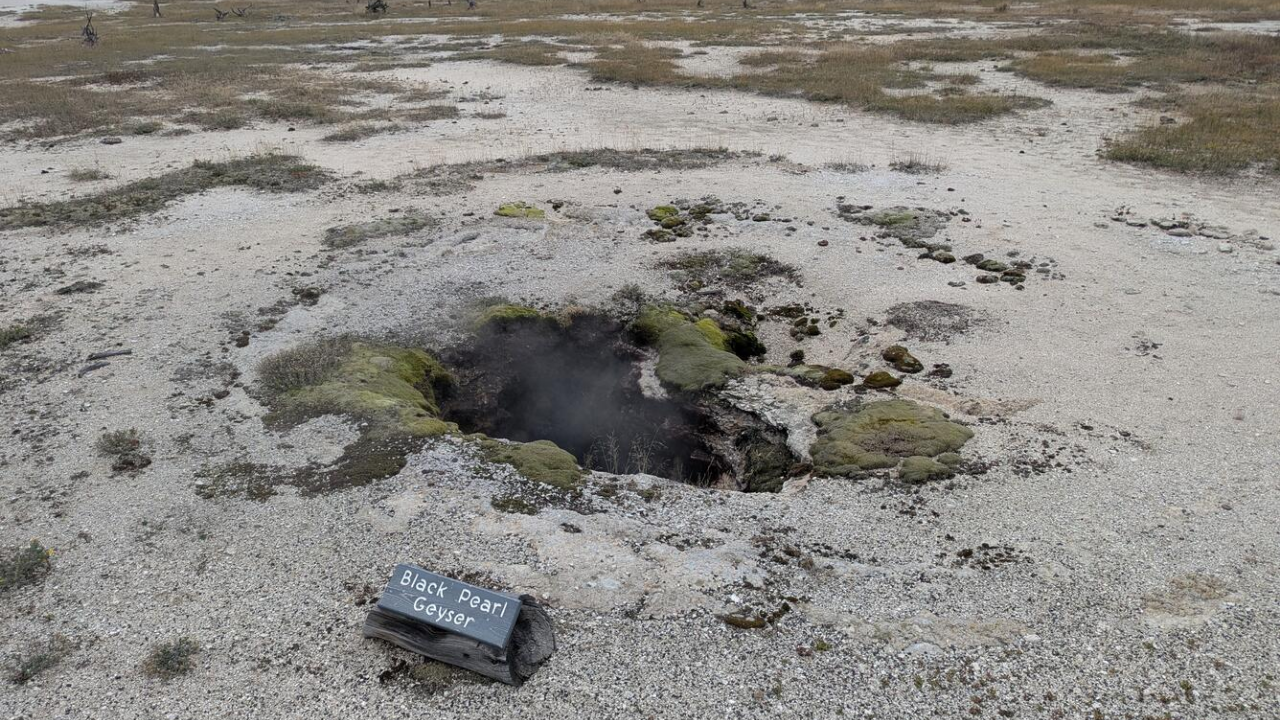
History isn't just written by the victors. Sometimes, it gets misplaced a thousand feet down the trail because a park sign ended up in the wrong spot.
Back in 1925, a sudden hydrothermal explosion ripped through Yellowstone's Biscuit Basin. Nobody saw it happen. When park staff finally walked out onto the shattered sinter crust to inspect the damage, they had to piece the timeline together from bare wreckage and scattered debris. Among the confusion was a weathered wooden marker bearing the name "Black Pearl."
There was just one catch. The sign sat a thousand feet away from the actual Black Pearl Geyser.
For over a century, that administrative goof warped how scientists and historians understood the basin's thermal evolution. Now, archival digging by the U.S. Geological Survey has unearthed a dusty paper trail from 1926 that explains how the mix-up happened in the first place.
The Mystery of the Unseen Blast
Hydrothermal explosions aren't gentle eruptions of lava. They are violent, subterranean steam flashpoints. Superheated water trapped beneath the surface suddenly flashes to steam, blasting apart rock, mineral crust, and mud with terrifying force.
When the Biscuit Basin blew in 1925, it tore open near the Firehole River. Because backcountry monitoring didn't exist back then, the eruption went entirely unwitnessed. Park rangers arrived post-blast to find a altered landscape featuring a newly enlarged thermal pool near Black Diamond Pool.
Naming these features became an exercise in guesswork. When visitors and staff stumbled across the "Black Pearl" sign near the fresh crater, they assumed the pool beside it was the famous geyser known for its dark, pearl-like mineral spheres.
They were wrong. The real Black Pearl Geyser sat nearly a thousand feet west. Meanwhile, other surrounding features like Wall Pool and Black Opal Pool added to the geographical tangle.
What the 1926 Letters Reveal
History often hinges on mundane paperwork. The truth behind the mislabeled landscape surfaced not from modern rock core samples, but from handwritten correspondence stored deep in park archives.
On August 15, 1926, Old Faithful ranger J. R. Van Pelt sat down to write a letter to J. E. Haynes, who served as acting director of the Yellowstone Park Museum. Van Pelt outlined the confusion left in the wake of the previous year's explosion, pointing out that signage had drifted from its true geographical coordinates.
Eleven days later, Haynes replied. His August 26 letter confirmed the error and kicked off instructions to get park painters and rangers to haul the signs back to their legitimate homes.
Back then, communication moved at the speed of a postal horse or a delayed train. Once the letters were filed away, the memory of the signage mix-up faded. The mistaken locations quietly baked into early records, misleading anyone trying to cross-reference historical thermal changes with modern geology.
Why a Thousand-Foot Error Matters Today
You might wonder why an old signboard matters when rocks and water are constantly shifting anyway.
In Yellowstone, names anchor the scientific record. Thermal features are notoriously fickle. They go dormant, explode, merge, or vanish entirely. When researchers track long-term volcanic and hydrothermal trends, they rely heavily on historical observations. If a benchmark name points to the wrong pool, baseline data breaks down.
The 1925 explosion left scientists guessing because the event had no eyewitnesses. The misplaced sign piled an extra layer of human error on top of nature's chaos. It proves how fragile archival data can be when an era relies purely on analog notes and physical markers.
The Changing Face of Biscuit Basin
This historical detective work hits home because Biscuit Basin refuses to stay still.
Recent activity proved that Yellowstone's underground plumbing remains intensely active. A dramatic hydrothermal explosion tore through Black Diamond Pool, sending tourists scrambling and reshaping the basin's walkways.
Today's scientists don't have to guess or wait for a ranger to write a letter weeks later. The Yellowstone Volcano Observatory now blankets these high-risk areas with modern monitoring equipment, real-time cameras, and seismic sensors. They capture steam spikes and crust failures as they happen.
The misplaced Black Pearl sign serves as a reminder that science is a messy human endeavor. Archives hold answers, but only if someone cares enough to read the old ink and question where things stood a century ago.
Check your sources, question the map labels, and remember that even national parks have a sense of humor when it comes to playing hide-and-seek with history.


