The lines separating political commentary, partisan advocacy, and the White House press corps have basically evaporated. When twenty-four-year-old Beni Rae Harmony transitioned from covering Donald Trump as a correspondent for Real America's Voice to serving as an assistant White House press secretary, it wasn't just a career move. It was the latest proof that the modern political apparatus no longer hides its preference for cheerleaders over questioners.
Critics immediately dug up a 2021 holiday photograph showing Harmony holding a rifle alongside an older relative while wearing a shirt bearing an explicit anti-Biden slogan. Instead of dodging the controversy, the administration leaned right into it. Deputy press secretary Anna Kelly defended the hire by praising Harmony as a trusted voice for the Make America Great Again movement. The administration didn't try to distance the new staffer from her overtly partisan past. They celebrated it.
This appointment highlights a broader structural shift in how executive branch communications operate. Gone are the days when presidential press aides tried to maintain a thin veneer of institutional neutrality. Today, the Trump administration actively recruits from the ecosystem of right-wing digital outlets, podcast networks, and congressional firebrands. Before her stint as a correspondent, Harmony worked on crisis communications for hardline Republicans like Matt Gaetz and Paul Gosar, and produced content for Jack Posobiec. Her trajectory tells you everything you need to know about the current talent pipeline in Washington.
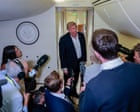
The relationship between friendly media and the administration runs deeper than resumes. Reports surfaced pointing to an Air Force One press gaggle where Harmony lobbed softball questions designed to help the president score political points. Eyewitness photographs from the event showed Trump holding a physical packet with Harmony's name at the top. The optics were striking, suggesting that questioning the president has become less of an adversarial accountability check and more of a scripted audition.
Traditional political journalism likes to frame these events as shocking departures from democratic norms. But you're missing the point if you think anyone inside the West Wing cares about institutional norms. They view the mainstream press corps with open hostility, routinely sidelining outlets like CNN while reserving prime questions for commentators whose loyalty is unquestioned. Swapping out a reporter's notebook for a press secretary's badge is just the logical endpoint of a system built on total brand alignment.
If you want to understand where modern political communication is heading, stop looking for objective referees. The press office isn't trying to inform a broad public anymore. They're building a closed-loop media machine where online influencers, partisan correspondents, and official spokespeople speak the exact same language. Harmony isn't an anomaly. She's the blueprint.