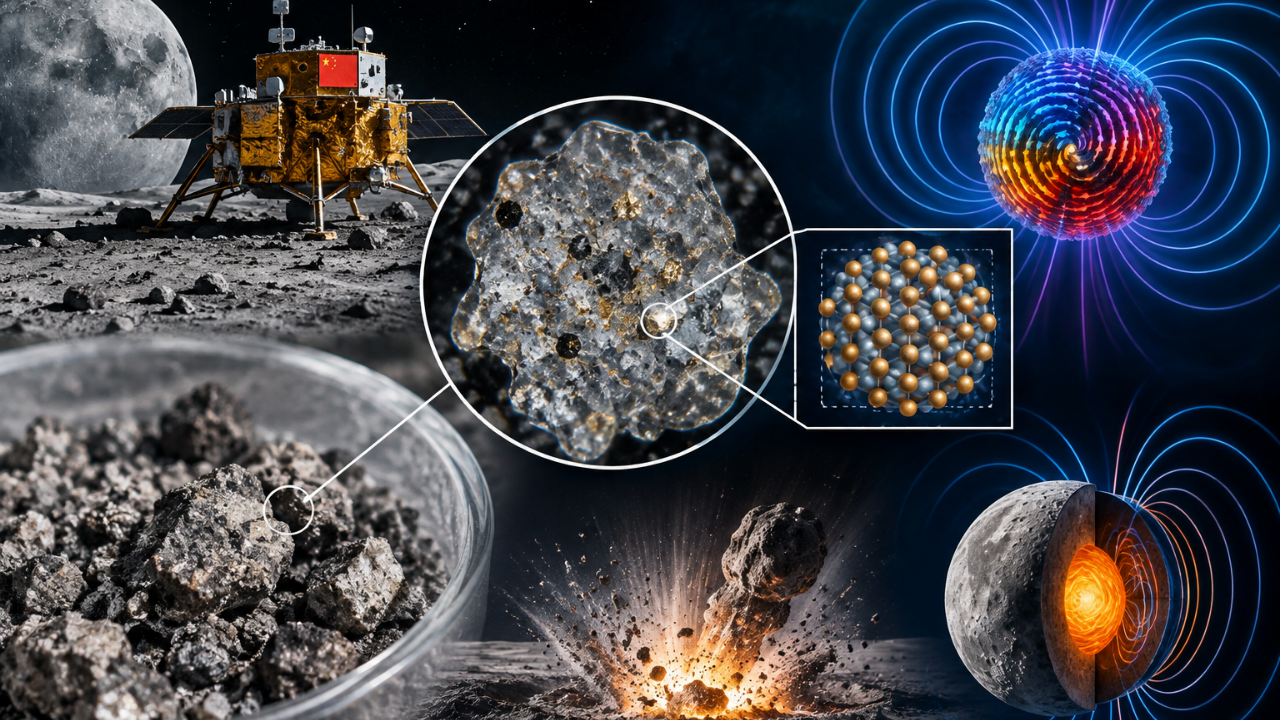
When China's Chang’e-6 capsule touched down with soil samples from the lunar far side, planetary scientists knew they were getting a first-ever look at untouched geological terrain. Nobody expected to find a strange, hidden metallic phase locked away inside microscopic glass beads. Researchers from the Chinese Academy of Sciences spotted something remarkable: face-centred cubic gamma iron, an unusual form of metallic iron never previously recorded in natural lunar samples.
This isn't just a quirky mineralogical curiosity. These tiny particles could unlock the mystery of how the Moon generated a roaring magnetic field billions of years ago and why that shield eventually vanished into thin air.
The Mystery of Gamma Iron
Iron doesn't like to stay in just one crystal configuration. Depending on ambient heat and pressure, it shifts its atomic structure around. Gamma iron, or gamma-Fe, typically forms under intense high-temperature environments. Once temperatures drop back down, gamma iron usually transforms into stable alpha iron. It refuses to linger in its high-temperature state under normal conditions.
So how did it survive on the lunar surface?
The answer lies in violent collisions. When space rocks smash into the lunar surface at hypervelocity speeds, they generate extreme temperatures and pressures that instantly melt surrounding minerals. This molten soup cools at astonishing speeds, trapping transient mineral phases before they can revert to normal.
Trace amounts of carbon and other interstitial elements likely jumped into the mix, acting like a chemical freeze-frame that locked the gamma-iron structure in place inside tiny impact-glass grains.
Capturing the Ancient Magnetic Record
What makes these microscopic iron inclusions so exciting is their physical behavior under off-axis electron holography. When scientists inspected individual gamma-iron nanoparticles, they noticed something weird. Larger particles displayed a single-vortex magnetic state. Instead of acting like standard uniform magnets, their magnetic fields curled into stable microscopic whirlpools.
These vortex structures matter because magnetic minerals act like microscopic hard drives. When minerals form or cool in the presence of an external magnetic field, they record that field's strength and direction.
Today, the Moon is basically a magnetic dead zone. It lacks a global magnetic field, leaving its surface exposed to harsh solar wind. Yet old Apollo-era rocks and orbital data prove that the Moon once possessed a surprisingly powerful core dynamo, perhaps even rivaling Earth's field strength at points in its history.
For decades, planetary geologists have argued over how strong that ancient field was, when it fired up, and why it died. Deciphering that history is notoriously tricky because subsequent asteroid impacts repeatedly scrambled the magnetic signatures baked into ordinary lunar surface rocks.
Why Far Side Samples Change the Game
Chang’e-6 landed inside the South Pole-Aitken Basin. This gargantuan impact structure spans roughly 2,500 kilometers across the lunar far side, making it one of the oldest and deepest impact scars in the solar system. Because the far side avoided the massive volcanic flooding that formed the smooth dark maria on the near side, it preserves a much older, more chaotic chapter of lunar evolution.
The discovery of gamma iron inside these far-side impact glasses gives researchers a fresh proxy to test. If these microscopic vortex-state iron grains can reliably separate primary magnetic signals from the shock-induced magnetism of later impacts, they give scientists a precise timeline of the lunar core dynamo's rise and fall.
Pinpointing when the lunar dynamo shut down tells us how planetary interiors cool down over time. Small planetary bodies lose their internal heat much faster than Earth, which starves the convective liquid metal currents needed to drive a magnetic field. By dating the glass grains housing these iron particles, researchers can put hard numbers on when the Moon's interior engine finally ground to a halt.
Further analysis is required to confirm how well these tiny iron inclusions hold onto their magnetic memories over billions of years of cosmic radiation and thermal cycling. But the physical evidence is right there, sealed inside natural glass beads harvested from a hemisphere humanity could only photograph until recently. The Moon's quiet surface still holds violent secrets, waiting in dust grains smaller than a speck of pollen.